
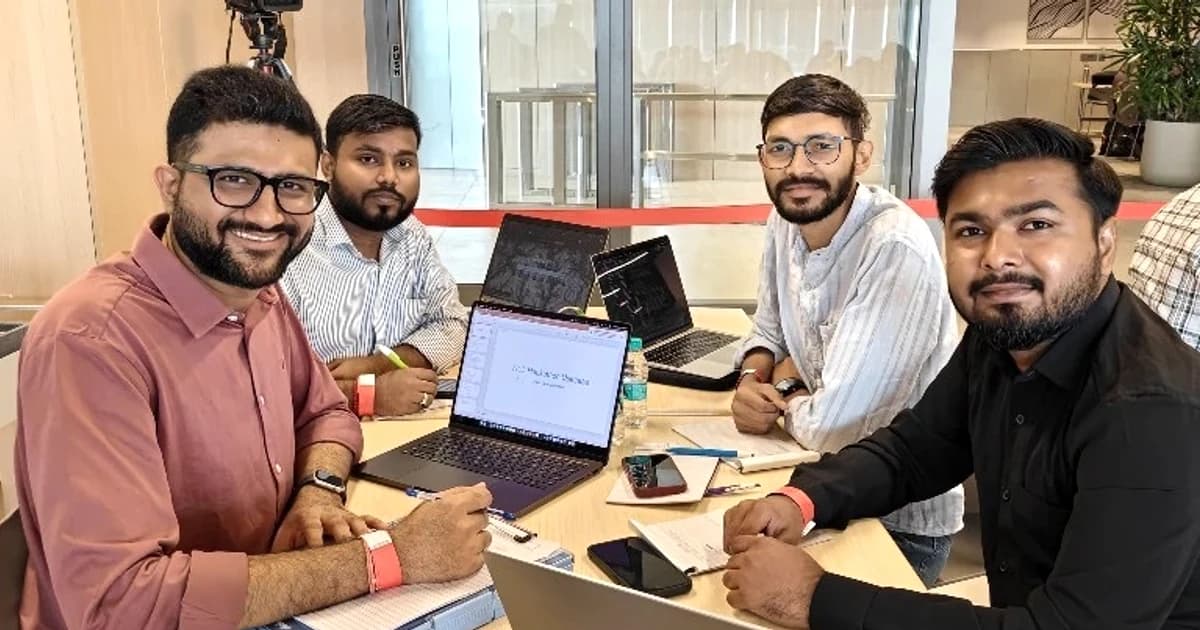
When I first heard that HCLTech was organizing a hackathon at GIFT City, Gandhinagar, I saw it as more than a coding competition.
It felt like an opportunity to solve a real fintech problem, collaborate with strangers under pressure, and test whether practical engineering skills still matter in an era where AI tools are becoming part of everyday development.
I learned about the event on April 27, 2026, and applied as a Java full stack developer. A few days later, I received a call from HR. She asked about my experience, my current organization, and the kind of projects I had worked on.
After that conversation, I received the official invitation for the hackathon on May 9, 2026, at the newly opened HCLTech GIFT City office.
Hackathon day at GIFT City
The hackathon was scheduled for May 9, 2026, from 8:30 AM to 6:30 PM.
When I reached the venue, there was already a queue for registration. The HCLTech team managed everything smoothly, and the hospitality was impressive.
We gathered in a ballroom with candidates, jury members, and organizers. I did not know anyone there, so the environment felt new at first. Soon after, one of the jury members introduced us to HCLTech, its client base, and its future plans for the GIFT City location.
Around 10 AM, three QR codes were presented on the screen:
- Java full stack
- Java backend
- AI and Data
Each QR code had a problem statement for that track. Based on our stack, we were divided into groups and moved to our workspaces.
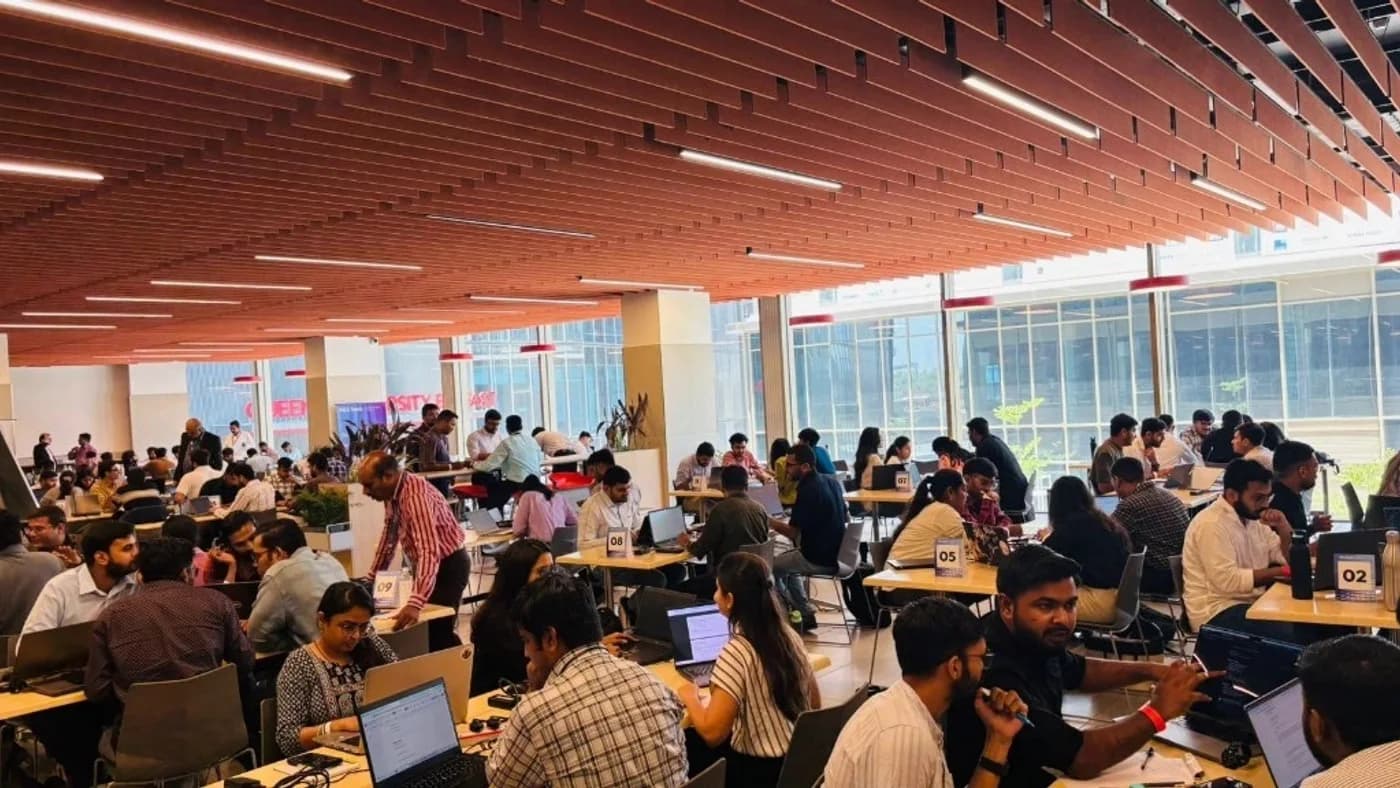
Team 03 and the fintech challenge
Teams were randomly formed with four developers from the same stack. I was allotted Team 03, where I met three new candidates who became my teammates for the day.
We introduced ourselves, discussed our experience, and quickly understood each other's strengths. We were strangers in the morning, but within a short time we had to operate like a real engineering team.
The problem statement was based on fintech. It revolved around banking, credit cards, credit scores, and the kind of system that needs strong backend thinking.
Sanitized problem statement
Credit card application system
Build a Java full stack credit-card flow: application, score check, card allocation, and first-time PIN update.
- 1
Apply
Customer, employment, and identity details.
- 2
Score
Existing score or salary/card-count calculation.
- 3
Approve
Allocate a card type or request documents.
- 4
First login
Validate card details and update the PIN.
Because we were in the Java full stack track, Java was mandatory, and we chose ReactJS for the UI.
Our planned solution consisted of:
- Customer onboarding service
- Credit score evaluation service
- Card approval workflow
- Kafka-based event communication
- API Gateway for routing
- ReactJS frontend for customer and admin workflows
Since the challenge duration was limited, we focused on delivering a working end-to-end flow rather than trying to implement every advanced feature perfectly.
The first hour was dedicated to system design. We discussed the flow, drew the architecture on paper, divided responsibilities, and thought through how services should communicate. After that, we presented our design to the jury, answered their questions, and received approval to start development.
My contribution and team alignment
I primarily focused on backend architecture and business workflow design. I worked on defining service boundaries, thinking through API flows, implementing core backend functionality, and helping the team stay aligned around a practical solution that could be delivered within the available time.
The hackathon also reminded me that engineering is not only about writing code. A team has to align on architecture, divide responsibilities, manage different viewpoints, and make trade-offs under tight deadlines.
Several times, we paused implementation discussions to make sure everyone shared the same understanding of the problem before moving forward. That clarity helped us reduce confusion and keep momentum.
Functionality over complexity
One of the biggest realizations from this hackathon was that selection is not only about complex DSA.
DSA and fundamentals are important, but in a hackathon like this, the bigger opportunity is to prove that you can build working functionality under pressure.
The jury was not only looking for who could write the most complex algorithm. They were looking for whether we could understand a business problem, design a practical system, divide work, build features, connect services, handle data, and explain trade-offs clearly.
In real projects, users do not care how fancy the internal solution looks if the functionality does not work. They care whether the system solves the problem reliably. This hackathon reminded me that practical delivery matters as much as theoretical knowledge.
Building under pressure
Designing microservices, coordinating modules, thinking through Kafka, handling API boundaries, and building a frontend within a few hours required focus.
Around 1 PM, lunch was served, but our conversations never really left the problem statement. Even over lunch, we were debating trade-offs, refining workflows, and looking for ways to simplify delivery.
At one point, I told my team that we should cut through the noise and trust our own design. That helped us regain confidence and continue with better energy.
The AI lesson
One observation surprised me. Every participant had access to AI tools, yet the quality and completeness of solutions varied significantly.
The differentiator was not access to AI. It was the ability to provide the right context, verify outputs, and make engineering decisions.
AI accelerated development, but understanding the business problem remained a human responsibility.
If your fundamentals are strong, your business logic is clear, and your prompts include enough context, AI can help you move faster. But if the foundation is weak, AI will not magically build the right system.
AI can accelerate implementation, but debugging, validation, and engineering judgment still require human ownership.
So the developer still owns the responsibility:
- Understanding the business problem
- Designing the system
- Choosing the right database flow
- Knowing where Kafka, caching, or APIs fit
- Reviewing generated code
- Debugging with clarity
AI can reduce effort and speed up development, but the responsibility of building a robust system still belongs to the developer.
Final presentation and result
Around 6 PM, we submitted our project with multiple microservices and the frontend work we had completed.
Then came the final presentation. We explained our architecture, modules, approach, and functionality to the jury. I am glad to say that my team did a really good job under pressure. By the end of the day, we exchanged contact numbers and stayed connected.
After the presentation, I thanked HR again for the opportunity. HCLTech also gave us a coffee mug with the HCLTech logo on it, which became a small but memorable part of the experience.
A few days after the hackathon, on Tuesday, May 12, 2026, I received an email from HCLTech informing me that I had been provisionally selected to move forward in the hiring process for the Senior Technical Lead role.
Since then, I have received the formal offer letter for the role and accepted it. My expected joining date is July 1, 2026.
That moment felt special. It felt like an important milestone in my career, an opportunity to take on greater responsibility, work on larger-scale systems, and contribute within one of India's leading technology organizations.
Technologies Used
- Java
- Spring Boot
- ReactJS
- Apache Kafka
- Microservices architecture
- REST APIs
- API Gateway
- Relational database design
- AI-assisted development
Key takeaways
- Functionality beats unnecessary complexity.
- Strong communication is as important as strong coding.
- AI accelerates development but does not replace engineering judgment.
- Working under time pressure reveals real team dynamics.
- Practical problem-solving creates more value than theoretical perfection.
Starting a new chapter
The hackathon reminded me that technology is ultimately about solving problems for people.
Tools change, frameworks evolve, and AI continues to advance, but the ability to understand a problem and build a practical solution remains timeless.
I am grateful to HCLTech, the HR team, the jury, and everyone who organized the event.
More importantly, I am thankful for the lessons the hackathon reinforced: practical thinking, teamwork, clear communication, and disciplined execution.
With the offer accepted, I am preparing for the next chapter of my career at GIFT City. Those lessons will stay with me far longer than the competition itself.
I plan to continue documenting this journey after I join HCLTech and share what I learn from the transition, the role, and working at a larger scale. Stay connected for the next chapter.
And if there was one lesson that stood above all others, it was this: delivering a working solution under real-world constraints is often more valuable than designing a perfect solution that never reaches production.